[ Back to home page ]
Kimpo, R. R.*, Boyden, E. S.*, Katoh, A., Ke, M. C., Raymond, J. L. (2005) Distinct patterns of stimulus generalization of increases and decreases in VOR gain, J. Neurophys. 94:3092-3100.
(* these authors contributed equally to this work)
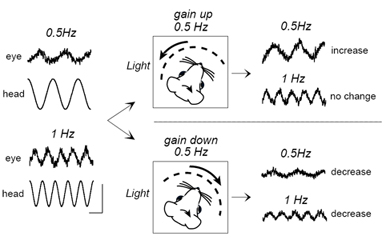
Distinct patterns of stimulus generalization of increases and decreases in VOR gain
Abstract
Motor learning must be capable of increasing or decreasing the amplitude of movements to meet the demands of the environment. One way to implement such opposite learned changes would be to store them with bidirectional plasticity mechanisms (i.e., LTP and LTD at the same synapses). At the behavioral level, this scheme should result in similar patterns of stimulus generalization of increases and decreases in movement amplitude, since the same synapses would be modified, but in opposite directions. To test this idea, we quantitatively compared the stimulus generalization of learned increases and decreases in the gain (amplitude) of the vestibulo-ocular reflex (VOR) in mice and in monkeys. When examined across different sinusoidal frequencies of head rotation, decreases in VOR gain generalized more than increases in gain. This difference was apparent in both the gain and the phase (timing) of the VOR. Furthermore, this difference held when animals were trained with high-frequency rotational stimuli, a manipulation which enhances frequency generalization. Our results suggest that increases and decreases in VOR gain are not exact inverses at the circuit level. At one or more sites, the plasticity mechanisms supporting decreases in VOR gain must be less synapse-specific, or affect neurons more broadly-tuned for head rotation frequency, than the mechanisms supporting increases in gain.Copyright © 1995-present, Ed Boyden